
SPONDYLOLISTHESIS (Listhesis) TREATMENT IN MUMBAI
Lower back pain that worsens when standing or walking?
It could be spondylolisthesis, a condition where one vertebra slips over another, causing instability and pain.
With the right treatment, most patients can manage symptoms effectively and return to normal life.
WHAT IS SPONDYLOLISTHESIS?
Spondylolisthesis comes from the Greek words:
Spondylos – vertebra
Listhesis – slipping
CAUSES OF SPONDYLOLISTHESIS
1. Developmental (Congenital)
Natural defect or gap between vertebrae (called lysis)
Present from early life
It refers to the abnormal slipping of one vertebra over another, leading to:
Spine instability
Mechanical back pain
Possible nerve compression
This is essentially a mechanical problem of the spine, where stability is compromised.
2. Degenerative (Age-related)
Wear and tear of joints and ligaments
Weakening of spinal support structures over time


SYMPTOMS OF SPONDYLOLISTHESIS
Many people may not have symptoms.
When symptoms occur, they typically include:
Lower back pain (most common)
Pain worsening with standing, walking, or bending
Pain relieved by rest
DIAGNOSIS
A proper diagnosis helps determine severity and treatment.
Common tests include:
X-rays
Show bone structure, alignment, and curvatureDynamic (Flexion/Extension) X-rays
Detect abnormal movement or instabilityMRI Scan
Evaluates nerves, discs, and spinal cord
Identifies stenosis or nerve compressionCT Scan
Provides detailed images of bone anatomy
Note: These symptoms may overlap with other spine conditions. A proper medical diagnosis is essential.
This is known as mechanical back pain.
In some cases:
Leg pain (sciatica or radiculopathy)
Numbness or tingling in the legs
Muscle weakness
Nerve-related symptoms due to compression
NON-SURGICAL TREATMENT (FIRST LINE OF CARE)
Most patients improve without surgery.
Treatment includes:
Physiotherapy
(Strengthening back, abdominal, and core muscles)Posture correction and ergonomic training
Anti-inflammatory medications
Pain management for flare-ups
(including spinal injections if required)Weight management and lifestyle modification
WHEN IS SURGERY REQUIRED?
Surgery is considered when:
Severe or persistent back or leg pain
Symptoms not improving with conservative treatment
Progressive nerve symptoms (weakness, numbness)
These measures help stabilize the spine and reduce symptoms.
SURGICAL TREATMENT
The goal of surgery is to:
Relieve pressure on nerves
Realign the spine
Stabilize the affected vertebrae
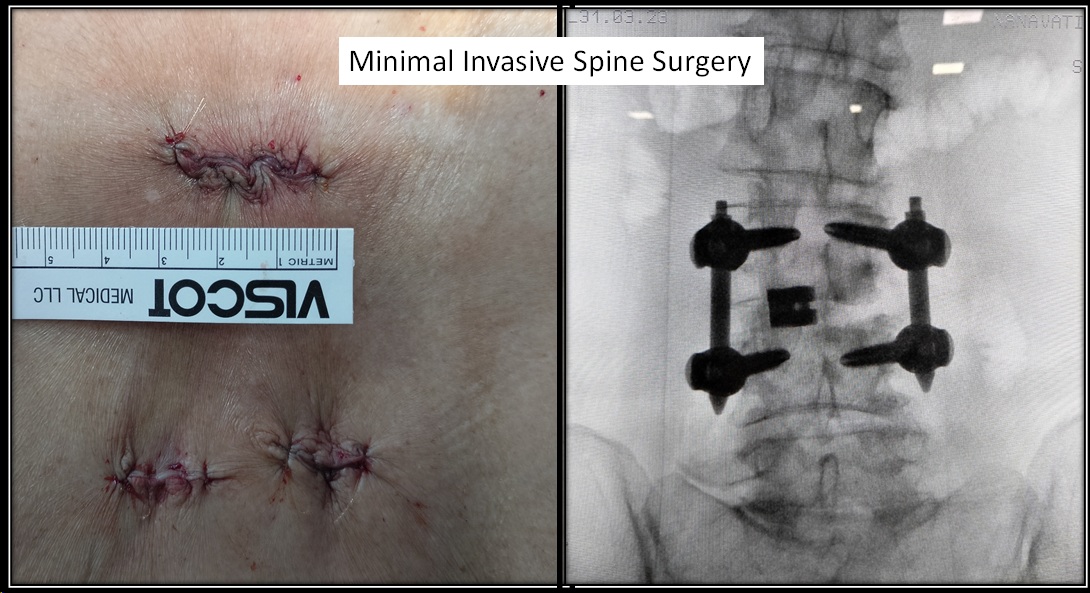
Modern techniques often use minimally invasive methods for faster recovery.
This involves:
Removing pressure from nerves
Fixing the vertebrae in correct position using implants
Common procedure:
Minimal Invasive Decompression + Spinal Fusion
RECOVERY & LONG-TERM CARE
Recovery focuses on:
Gradual return to activity
Core strengthening exercises
Posture correction
Lifestyle changes
These help maintain spine stability and prevent recurrence.
Frequently asked questions
Can spondylolisthesis heal without surgery?
As it is a mechanical issue, we can try to control the ailment, in many cases.
Most patients improve with:
Physiotherapy
Medications
Activity modification
Lifestyle changes
Surgery is only required in severe or non-responsive cases.
Is walking good for spondylolisthesis?
Yes, controlled walking is generally beneficial.
Helps maintain mobility
Improves circulation
Supports recovery
However, excessive or painful activity should be avoided. A guided plan is best.
What activities should I avoid?
Heavy lifting
Sudden bending or twisting
High-impact activities
These can increase instability and worsen symptoms.
What is the best treatment for spondylolisthesis in Mumbai?
The best treatment depends on your condition.
It usually includes:
Accurate diagnosis (MRI, X-ray)
Non-surgical care first
Minimally invasive surgery if required
A personalised treatment plan gives the best results.
Can I live a normal life post surgery for spondylolisthesis?
Yes. With proper care, exercise, and posture correction, most patients:
Return to normal activity
Stay pain-free long-term
Avoid recurrence
When should I see a spine specialist for back pain?
You should consult a specialist if you have:
Persistent lower back pain
Pain increasing with standing or walking
Pain radiating to the legs
Numbness or weakness
Early diagnosis leads to better outcomes and prevents progression.
Is this a safe procedure?
This is safe and effective surgery that allows immediate restoration of activity. The chances of nerve injury are minimized by use of a microscope. The complication rate can be placed at 1% or less.
Surgical Illustration
Dr. Amandeep Gujral is a leading Minimally Invasive Spine Surgeon in Mumbai.
He specializes in Minimally Invasive Spine Surgery (MISS) and treats conditions like slip disc, sciatica, neck pain, spine deformity, infections, and tumors.
Providing advanced, patient-focused spine care across Mumbai.
Board certified spine surgeon in Mumbai.
© 2026 Spinecareindia.com |
Dr. Amandeep Gujral & Spinecareindia.com.
All Rights Reserved.
The information on this website is for general educational purposes only and is not a substitute for professional medical advice.